
I am a huge fan of the Indiana Jones movies, and just went to see the newest one, Indiana Jones and the Dial of Destiny on opening night with my son. (I loved it, but I’m biased.) One of my favorite moments in the series, though, comes in 1989’s Indiana Jones and the Last Crusade.
Indy has been on a search for the holy grail (in a somewhat more serious quest than Monty Python’s) and when he finally makes it to the room where the grail is located, there is not one grail, but dozens. The knight guarding the grail tells Indy – and the villainous Nazi who has followed him into the chamber – that he must chose wisely. The true grail brings life, but the false grails bring death. Of course the Nazi picks a fancy, bejeweled cup, drinks it, and nearly instantly ages, turns into a skeleton, and falls into pieces.
The knight, a master of understatement, utters my favorite line. “He chose… poorly.”
I often see my students (and sometimes others in my life, including myself) making poor decisions, and the knight’s words echo in my head. “He chose… poorly.” Or she:
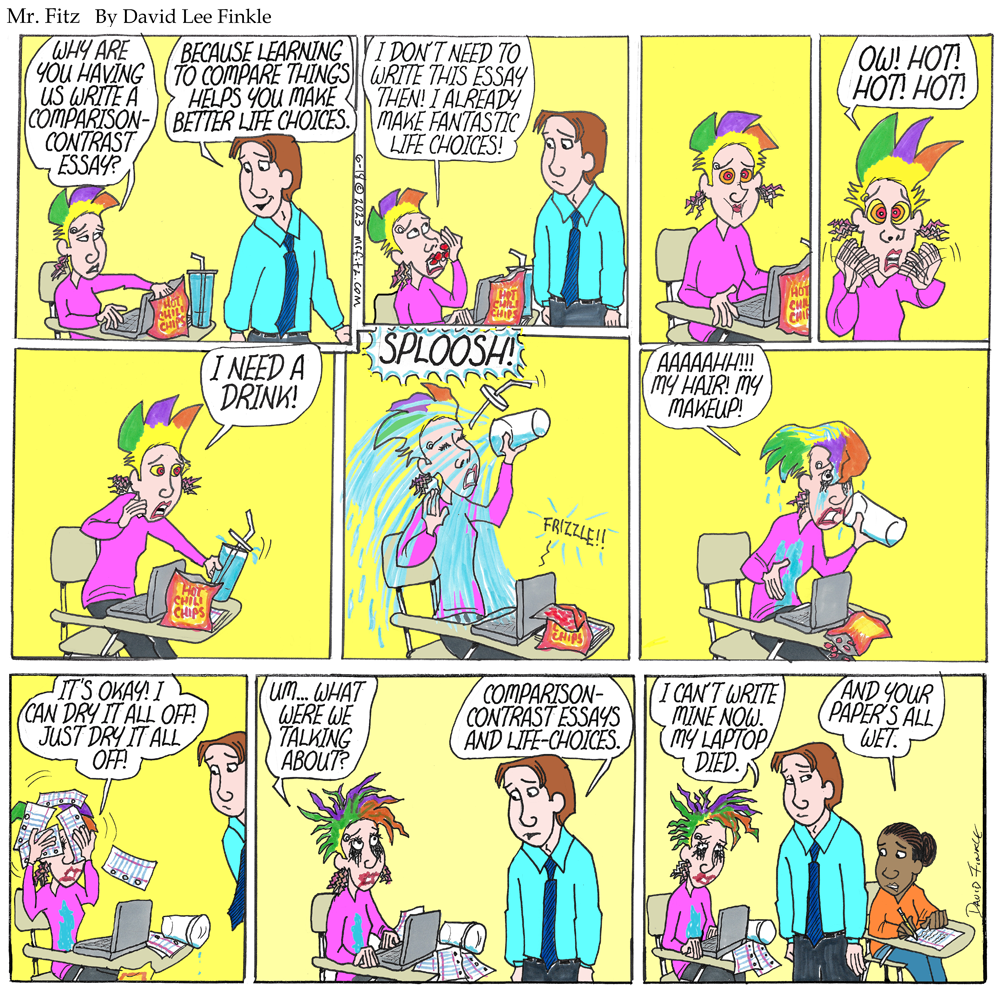
This is so simple as to seem too obvious, but if you want writing to be relevant and engaging, let students write about decisions they have made, or let them write about decisions made and why they did or didn’t work.
One of main benefits of writing, so far as I have been able to figure out, is that is helps you make decisions. Writing gives you a chance to get all your options out of your head and onto a piece of paper or a screen. Once there, you can look at them all, write about the pros and cons, and weigh your options. Until you have tried to figure out what all your options are, how could you ever make a decision? You don’t know what all your choices are.

For comic effect, of course, I have the students in my comic strip not quite see the benefit of writing to help them make decisions, but in real life, I have seen students benefit from this type of writing. I have, too. Whenever I have some decision to make, I nearly always go to my journal and, as I suggested above, weigh the pros and cons. There are very simple ways to get students to weigh (pardon the pun) their options in writing.
Have students write comparisons between low-stakes choices the face: two products, two movies, two streaming services, two computer games or programs, two options for going out to dinner. I live in a town that is considered the pizza capital of Florida (more pizza places per capita than any other city in the state.) These comparisons can be bell-ringers or full assignments.
Have students write about characters’ choices in literature. What could they have done differently? What would have been the result? I have found this particularly effective to do with Shakespeare plays. Romeo and Juliet is just one bad decision after another.
Have students write about past decisions they have made. What was the choice? How did they choose? What were the results?
Have students write about a decision they are about to make. This does not need to be public writing – like a lot of beneficial writing, it can be done for an audience of one – yourself.
I remind my students that a comparison essay doesn’t need to be limited to just two choices. Despite living in a digital age of zeroes and ones, our thinking does not need to be binary. I remind students to brainstorm all their options.
I also remind them that sometimes the best option is to combine options. Stephen Covey called this synergy: finding a third way that is better than isolated options – a third way that combines the best features of options and transcends them.
I also remind students that sometimes it’s okay to write an essay in which you think and compare options on paper – let your reader see your thinking. Don’t start with a thesis – arrive at one. Take your reader on a journey as you consider the decision you have raised at the beginning of the paper.
Sometimes the decisions they need to make are about writing itself – if we allow them to make choices. As I have pointed out in past Moving Writers posts, our educational system, in an attempt to make writing measurable, too often takes away all of our students’ choices as writers. We chose the topics, the focus, the organizational style, the types of text that will be used as text-evidence. I have even seen teachers use a template to proscribe what should go into each sentence of a paragraph. Letting students make their own choices as writers will not only help them become better, more confident writers; it will give them transferable practice with decision making.
In the end, writing itself – like life – is a series of choices we make.
Sometimes we’ll make sensible, safe choices. And that’s okay.
But sometimes in writing, as in life, we need to make bold choices.
Like ending an essay with a sentence fragment.
Images via www.mrfitz.com. Created by David Lee Finkle
How do you use writing to help students make choices? What choices do you give them as writers? You can connect with me on Twitter @DLFinkle or engage on Facebook at facebook.com/movingwriters to continue the conversation.
At Moving Writers, we love sharing our materials with you, and we work hard to ensure we are posting high-quality work that is both innovative and practical. Please help us continue to make this possible by refraining from selling our intellectual property or presenting it as your own. Thanks!
 moving writers