

Jennifer has been teaching 10-12th grade English, AP lit, and Writing for the past 18 years, and recently she has launched her high school’s first Writing Center. She is looking forward to sharing specific Writing Center tips with the Moving Writers community!
This may be a bit meta, but my first post is both a lesson on- and my own expression of- writing identity.
Hear me out. As writers, we all have habits and behaviors, worries and vulnerabilities, but also strengths and unique perspectives. We know this as teachers and writers, but we rarely explicitly show or reveal those habits and vulnerabilities. Here’s my early admission: I am a nervous writer with many thoughts, notes, and outlines, but ultimately a writer who will freeze up. I am glad I got through that last sentence!
I teach a class entitled “Becoming a Better Writer” and students take it for a variety of reasons. It is an elective, so I get writers who love to write, resisters who were wrangled into the course by concerned parents or counselors, or newcomers who are aware of their shortcomings and would like to actively work on them. It is a glorious course and I, too, encompass all those writer personalities.
One of the first pieces of writing we do together is an apologia, a Greek expression, justifying a belief or course of action. It has a long history among theologians as a way to explain devotional life or one’s philosophy of life. Writers also must be devotional, set an intention, and remember why they must commit to a writing practice. In student terms- why are we taking this class?
For any writer, it is a question of our experiences and approaches to writing. Yet many students cannot name or speak to their approach or who they are as writers because they are often in the middle of that wonderful yet frightening process. For me, this is where we begin to lift the veil of what it means to be a writer.
An entry point
First, we discuss the habits of good writers. How can we have them if we don’t know what they are? I give students the following characteristics, excerpted from Carnegie Mellon’s Eberly Center, and ask them to sort these behaviors either using slips of paper or on our touch screens using Wordwall.
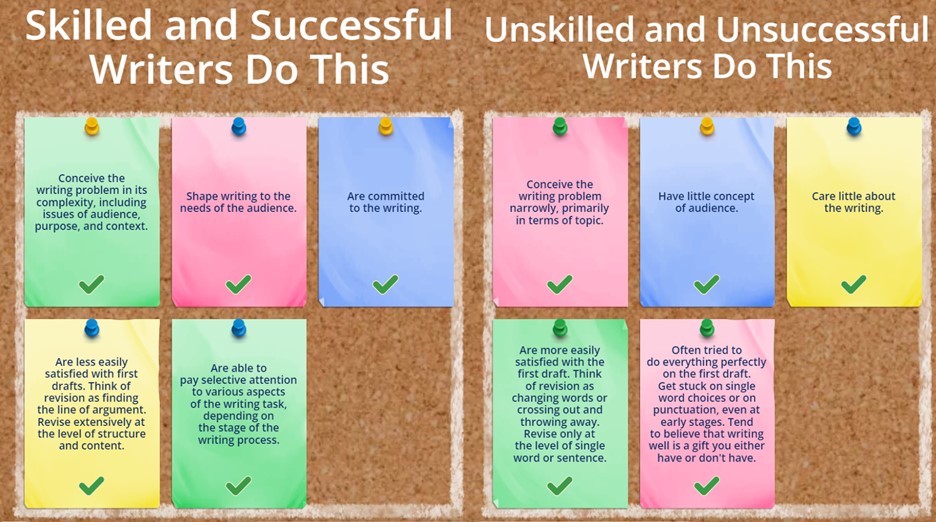
After we sort, we discuss, and jot down in our writer’s notebooks which habits we have and which we want to work on. The habit students tend to discuss most often is the “tried to do everything perfectly on the first draft” habit, which can lead to a kind of paralyzing perfectionism. It is an eye-opening exercise in knowing the writers in front of you and a fulfilling way to begin creating a classroom writing community.
Space and executive functioning habits
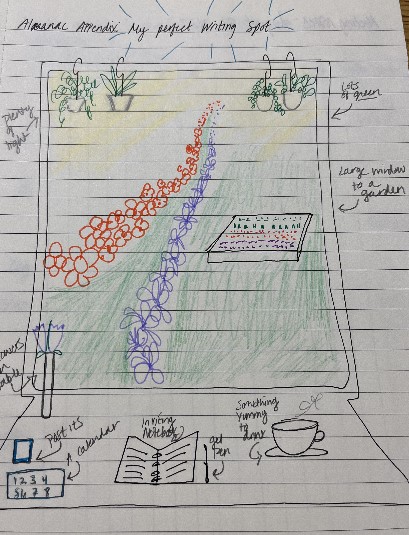
The next lesson we launch into is about our habits of space, focus, and motivation. I ask students to think about how, when, and where they are most comfortable writing and what sorts of support they need to begin. We discuss and think about areas of our room that are most conducive to focused writing and then we sketch our writer’s space, labeling our props and describing what such items do for our writing process.
Here is my example:
The Assignment
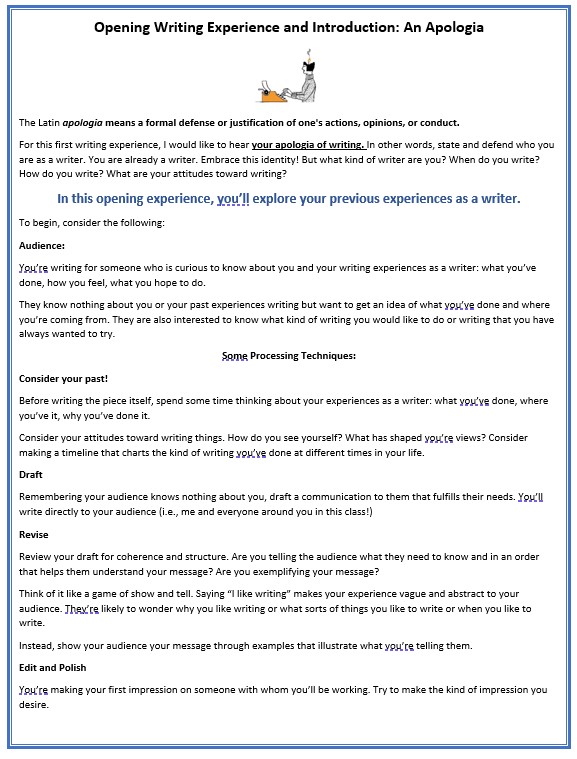
Once we’ve spent time prewriting, discussing, and sharing in the first two lessons, we are ready for the assignment, which is crafted and detailed with John Warner’s brilliant The Writer’s Practice , which sets the foundation for “writing experiences.” Here’s the assignment:
The Latin apologia means a formal defense or justification of one’s actions, opinions, or conduct.
For this first writing experience, I would like to hear your apologia of writing. In other words, state and defend who you are as a writer. You are already a writer. Embrace this identity! But what kind of writer are you? When do you write? How do you write? What are your attitudes toward writing? How did you come to have these attitudes, habits, or approaches?
In this opening experience, you’ll explore your previous experiences as a writer.
This early piece of writing discloses a writer’s history and how it has shaped their writing habits and attitudes. Here is an excerpt from a student:
As a writer I am many things, but I would like to think I am a distinct writer with my own creative style. Writing can turn your reality into another world, pulling you through the seam of your paper. In the past I have had many types of writing pieces. I have written thesis essays, important messages, poems and more. My most favorite thing to write is short stories, with the endless ways you can make your story twist and turn it makes the process and result that much more rewarding. Creative writing pulls me back to the past to a specific time in 4th grade. I was told to write a short story, it didn’t matter what it was about, it just had to be our own, I recall how excited I was to be able to create my own reality on paper. I would share my stories to younger peers and they would love hearing about the hundreds of characters I created within the walls of my mind. Most often I will be writing emails or texts, if you think about it, we are constantly writing and using it as one of our main practices of communicating.
-10th grade student
I love how I gain insight into this student’s 4th grade approach to writing and how it has affected this student writer today. It is also a glimmer into their writer’s voice and a piece we come back to as we engage in further writing in the course. With more writing experience, they have more to add in the apologia.
Some other ways to use this idea might be
- As a pre and post piece of writing that can show growth over a unit or course.
- An apologia of a reader!
- Apologia of an athlete, band member, or any other student interest/ identity.
- An apologia of a particular character, scene or decision from a novel.
Do you see other applications for this idea? Other ways for students to track their writing experiences and growth? Send them my way @SouthWriting or jtannous@cbsd.org.
At Moving Writers, we love sharing our materials with you, and we work hard to ensure we are posting high-quality work that is both innovative and practical. Please help us continue to make this possible by refraining from selling our intellectual property or presenting it as your own. Thanks!
 moving writers