

All writers are vulnerable, but our multilingual writers carry especially vulnerable learning identities that can be complex and enriching. As our school has grown its ELD program, we have had to adjust our instructional tools to best fit these thinkers and writers. It can sometimes feel like we are all novices: teachers and students alike. Yet this rookie apprehension is exactly what teachers need in order to best approach the sensitivities and worries of these writers (because we feel like newbies, too!).
Breaking down these walls of concern happens when we are approachable, open to mistakes, and adaptable with play. As students file into my room, I ask “Como estas oye.” A few giggle, a few shout “bien,” and a few begin correcting my greeting by repeating “como estas hoy?” and a few begin to speak Russian or Ukrainian. I fumble, smile, we all nod. It is a humbling experience to know that about half of what you are saying is being understood and that for all your preparation and experience, you are indeed, in uncharted territory.
Yet play and repetition are universal, so when we lean into these two strategies, we are all on friendly turf.
We know that play can engage students cognitively, physically, socially, and emotionally; but most importantly, it can offer a low stakes approach to writing. With this in mind, we began an informational writing unit and focused on the ‘how to’ of any given topic.
Familiarize and Repeat
To kickstart this unit, we did something familiar and fun: sandwich making. At a desk with peanut butter, jelly, bread and a knife, we coaxed each other through the steps that go into making a sandwich. As conversation continued, I placed ‘sequencing’ transitions around the room and asked students to rephrase their instructions by using words that show chronology. We played around with what would happen if you put the peanut butter on first or if you spread the jelly first (a possible argumentation piece in the future?!).
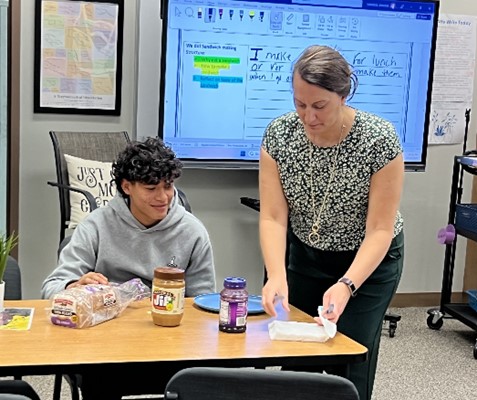
From this first experience, we dive into student chosen topics. The same sequencing words help structure our sentences and our paragraph. The repetition is key and with constant recognition, our writers (and I!) begin to feel more comfortable and gain confidence. Below, you will see my example and our class example, both of which reuse the same structures and color coding to help us recognize and reflect.

Play and Build Confidence
Confidence can also be instilled with the use of play and practice. As we continued this unit, I kept thinking of instructional manuals as model texts and I gathered a bunch to use as we discussed informational writing. These manuals also have the added bonus of multiple languages, which helps all of us recognize the power of all languages when learning a new one. We could clearly find and mark the sequencing words in everyday manuals and the students could compare the English word with the same word in Spanish, French, Chinese, or any other language the manual provides.
I then began to think about instructions without words: Ikea furniture and Legos. These also make for playful scenarios that are both real world and recognizable. These instructions can scaffold the language needed to write informationally, and that writing feels both authentic and manageable for our multilingual writers.
These low stakes moments of practice feel like play, and writing teachers can use this to leverage sentence and paragraph building. A later lesson began with baggies of Legos and students were tasked with creating a scene using just those Legos. As they built, they repeated instructional wording and varied some of the verbs they were using to construct their sentences. I also scaffolded with the following chart:

The results included a lot of talking, more writing, and a confidence that will hopefully transcend this activity.

What other real world, recognizable, and highly visual texts can we use for our multilingual writers?
Do you see other applications for this idea? Send them my way @SouthWriting or jtannous@cbsd.org.
At Moving Writers, we love sharing our materials with you, and we work hard to ensure we are posting high-quality work that is both innovative and practical. Please help us continue to make this possible by refraining from selling our intellectual property or presenting it as your own. Thanks!
 moving writers