

Forensic Science is one of the most popular electives at our school, which makes sense given how often students tell me that either Law & Order, SVU, Criminal Minds, or Cold Case is their favorite tv show.
Students are engaged by clues, puzzles, and intrigue. While ELA teachers lean into this engagement strategy when we explicitly teach reading (previewing, predicting, probable passaging, etc.), we can also use it as a powerful prewriting and drafting tool.
Picture this: each desk in your classroom- a miniature ‘investigation;’ the evidence- student artifacts; the truth to be discovered- student writers.
My own desk in implicated:
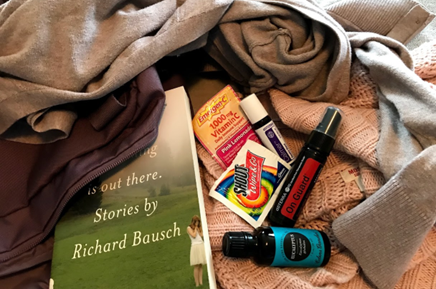
The first task is to dump portions of your bag onto the table as evidence of who you are. This activity works as a community builder and get to know you activity, but at its core is writer’s craft.
Students share and display what they are comfortable with, and we investigate the room by analyzing each student desk, looking to sort evidence and find some patterns. Students are prompted to become precise observers and to write down details like brand names, colors, and types of items displayed. Since these are personal items, the scenes must not be compromised and we all work investigatively, looking for clues that will connect and link us all as classmates.
At the end of this inquiry walk, we have a seat and look at our notes. As a whole class we discuss patterns, things that turn up in each ‘scene,’ such as Stanley mugs, salty snacks, chapsticks. I keep quick notes on the board about the patterns we see. After we’ve discussed our findings, we begin to select descriptive words for the group. I model this and use sentence stems to get us started:
Our class investigation revealed . . . . because . . .
The clues . . . . but . . .
As a class we . . . so . . .
I post these mini writes around the room for the next day when students are greeted by a model text from (of all places) US weekly. Yes, this grocery store relic reminder of long waits in check out lines can indeed prompt some cool structure for student writing. The model text is from their weekly spread, “What’s in My Bag”, which features celebrities and athletes along with a sneak peak into their bags and daily life details. For the best examples of this spread, I recommend image searches for the whole page (or snag an US Weekly the next time you are waiting in line and not scrolling through social media or some article like this one 😊). You can also take a look at the template I have created here.
While the writing in US Weekly isn’t necessarily the model per se, the idea and structure are a great tools for turning this opening forensic engagement into an introductory writing activity that focuses on style choices. Students review these one page spreads (as well as my own example) and annotate for structure. Here are some questions I ask them to annotate:
- What do you notice about the titles and subtitles?
- What do you notice about quoted material vs. descriptive material?
- What do you notice about punctuation, puns, references, and pacing of the sentences?
After we have a hearty list, I ask them to begin taking their own ‘scenes’ and turning them into a ‘What’s in my Bag’ spread. I offer this template and walk them through my model as well. The challenge is to get them to think about engaging their audience in quick bursts of stylish writing that expands on their ‘scene.’ To this end, I offer the year’s first minilessons on writer choices:
- Parenthetical asides vs. Em dash versatility
- Witty puns and rhetorical questions
- The right word, the right time- purposeful use of diction
- Sentence combining with appositives
As we workshop, I also take this first assignment as an opportunity to introduce revisions and what it means to comment on or speak to your own work (two avenues of writer workshop that I return to throughout the semester). During the revision stage, I ask them to decide on one significant addition and one significant change that they made. In other words, upon reviewing the evidence of our writing, which investigative leads work and which don’t? On their final draft, I ask students to write explanations of 2-3 of their choices, one change, and one addition.
Here is a student example of this writer choice reflection:

Writer’s Choices

“Animals, Animals, and more Animals?”

Like I said I love animals, the title was originally just animals, but I decided to add the extra animals because I felt it emphasized how much I love animals

“Is this too much technology?”

I choose to use this as the title because it was actually a question my mom asked when I was buying all my technology she said “Do you really need all of this, I mean a cylinder lamp that can be any color?”

“Wait, that’s what who said?”

Like I said I love The Office and one of the jokes throughout the show is Michael always says “That’s what she said” but never specified who so I thought it fit just right.

Significant Change

One change I made was that I substituted the title “Animals” with “Animals, Animals, and more Animals?” because like I stated earlier the longer one emphasizes how much I like animals better.

Significant Addition

One addition I made was that I added the sentence “I’ve had my lizard CJ since Christmas 2019 (I named him that because it is my initials backwards and I just like that name.” to add more detail in the “Wait, The lizard has a what?” section.
The day that students turn in this final piece of writing, we go back to those initial investigative notes. We again walk the room and take slightly different notes. We set the ‘scene’ again and now investigate with further evidence in the form of this student’s own writing. I ask students to consider
- What surprised you about this student based on how they introduced themselves in writing?
- What do we notice about the tone of the writer (this might differ with the ‘mood’ of the scene they created)?
- What choices did writer’s make? How are the objects described and a part of a larger pattern?
We have a lively discussion about each other and about our writing. It is the first entry point for our writer’s workshop, for discussing our identities, our vulnerabilities, our assumptions about each other, and our larger truths. Most of all it’s an engaging way to get to know each other and delve into writer’s craft.
What you choose to focus on can vary by grade and ability level, and the assignment is easily adaptable for many situations. I’ve had students write about
What’s in my gym bag
What’s in my suitcase
What’s in my room
What’s in my wristlet
What other ideas might work for writing forensically and taking a peek into the bags (or baggage?!) our students carry around?
Send your ideas my way @SouthWriting or jtannous@cbsd.org.
At Moving Writers, we love sharing our materials with you, and we work hard to ensure we are posting high-quality work that is both innovative and practical. Please help us continue to make this possible by refraining from selling our intellectual property or presenting it as your own. Thanks!
 moving writers