

Questioning strategies are a passion of mine. I’ve been doing some research into what academics call dialogic talk and what teachers call questioning for the better part of 25 years. Thinking about your classroom, I want you to consider the layered and nuanced dimensions purposeful questioning can take in your classroom.
First-Write Them Down
Do you write down a list of questions you will ask during a lesson? I want to propose to you that not only is it an excellent planning strategy as you assemble lessons for a unit, it is also a way to generate new ideas and creative avenues for your instruction.
When I taught 11th grade English, I wanted to expose my students to more a wider texts rather than a chronological stroll through American literature—and let’s face it, the early years are sparse with engaging texts. So I decided to grow that American literature standard and make sure my students read wide and deep in many literatures. I also wanted to expose students to writers who we not getting the reading time that many get in a textbook. I mean, how many times can we read “The Raven”? No offense to Edgar Allan Poe, but if you survey your vertical team from about 6th grade on up—you will be surprised how many years in a row that poem crosses students’ desks. Students deserve writers who reflect their communities and writers who wrote in this millennium.
When assembling a unit with What’s More Important: Freedom or Survival? as the focus, I began with a list of questions I had about the organizing theme:
- How would you define survival?
- What is freedom in this country? In other countries?
- Why are there geographical differences?
- How does survival shift based on socio-economic components?
- How do the definitions change based on gender?
- What novel, article, or poem have you read that hits on these topics?
This was a list of questions not only for me but also for me to pose to students as I presented a new text. Writing the questions down made me think about books I had read, excerpts to include in direct instruction, and poems to pull into anything we were doing related to this organizing theme. It made me put my students first when planning a lesson—something we must consider when we start to assemble lessons.
Second-Connect Questions to Student Agency
One of the pillars I stand on in all the work I do is that there should be less teacher-talk and much, much more student-talk in a classroom. Have a student set a timer; examine how much time you spend talking. It’s a humbling but necessary exercise. Planning questions ahead of time not only sways the balance back towards students, but it invariably helps you listen more. You begin to see questioning (and listening) as a tool for formative assessment. You start making notes of who:
- answers questions and who does not.
- struggles with which concepts.
- needs more processing time, less processing time.
- can make their own list of questions as a learning tool.
- helps other learners by rephrasing questions.
Planning different questions for different classes helped me differentiate my instruction based on student needs. It also helped me create agency in my classroom. My questions ventured far past recall and comprehension. I say all the time “I want to create THINKERS who read and write incredibly well, not readers and writers who don’t know how to think.” Good questions devised ahead of time spur instruction on both organically and dynamically; good questions allow students to think through a lesson in groups or independently.
Third-Do Research & Examine Models
When I started planning my teaching questions as the core of my lesson, I started noticing students responding to instruction differently—engagement increased drastically. I had attended a Shared Inquiry Discussion training my first year to teach; I then attended a refresher course my 5th year to teach. That second training made me the teacher I was for more than 30 years. The Great Books Foundation has discussion groups for adults, they do school trainings, they teach any type of reader to make critical decisions about a myriad of texts. They taught me to ask better questions.
Later in teaching, I ran across Charlotte Danielson and her framework in the ASCD book Questioning for Classroom Discussion. Jackie Wash and Beth Sattes do an incredible job working teachers through some valuable independent study to help enrich teaching and learning. (The newest version: Questioning for Formative Feedback from ASCD is connected directly with formative assessment.)
These two sources became not only places to which I returned, they molded me into a critical inquiry teacher and leader. They taught me more about teaching and allowing students to process a text more critically.
Fourth-Create Your Process
I’m still a physical handwriting processor. I like to see it on paper, use all the good pens, think through a text and what you want students to accomplish while working their way through it.
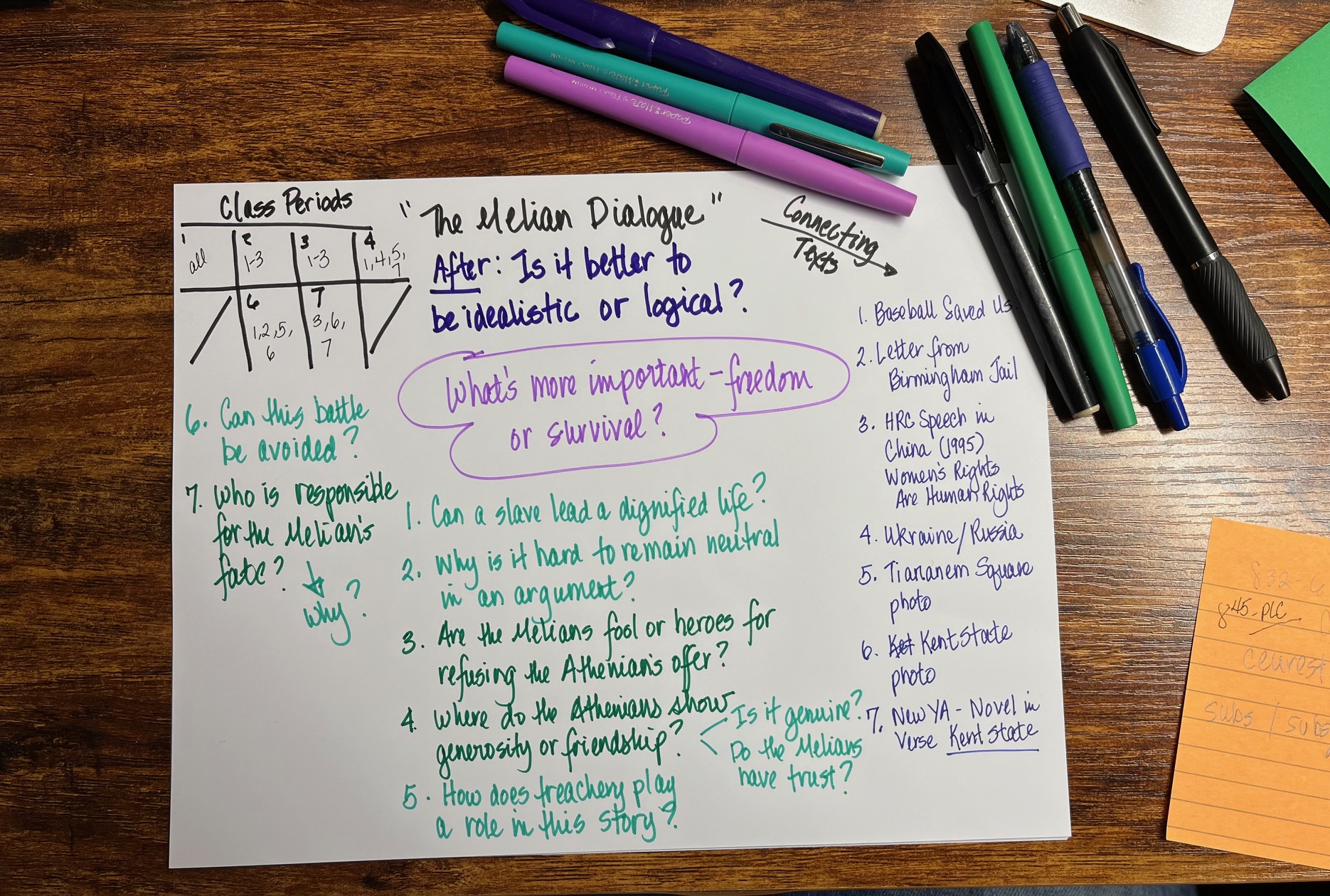
I would start with a question like you see in this picture as my central idea for a text. But students can be funny things. What you see in a text is not necessarily what they would see in a text. So I needed to have a backup. I needed to pick questions by class periods. Those choices were based on the students and what I wanted them to accomplish. As we all know, not all classes work at the same pace, level, or engagement with a text.
As I constructed questions, I also looked for connecting texts. I read picture books widely, and I read newspapers and news reports daily. I pay attention to what is being published so I can find a way to use it as a text or excerpt to increase student engagement. Every one of these sources help me build a unit of instruction that is engaging, current, and most importantly spurring students to find texts on their own and read more.
Use the style that works for you and begin planning instructional questions, think about new ways to engage students, and as always, reach out with any questions—even about how to get started. I’m here for all the advice. Contact me at: kellytumy@gmail.com
At Moving Writers, we love sharing our materials with you, and we work hard to ensure we are posting high-quality work that is both innovative and practical. Please help us continue to make this possible by refraining from selling our intellectual property or presenting it as your own. Thanks!
 moving writers