

On a recent sunny October morning, I laced up my sneakers and set out on a run through golden tree-lined paths in a park close to my house. The run was at a mild pace, the air fresh, and I was daydreaming while running. I ended the run red-cheeked but not overly winded or strained. It felt good and I enjoyed every moment.
This was a stark contrast to a few weeks prior when- on a similarly bright, crisp fall morning- my sneakers toed a ‘start’ line instead of the tree line. That run was at a more moderate pace and instead of daydreaming, I was locked in, laser-focused and competitive. It felt challenging and I felt proud of every moment.
These two experiences reminded me of how we train our writers and ways we can also push them to feel enjoyment in, feel challenged by, and feel proud of their writing. Sometimes our pace and our skills are more fluid like that Sunday morning run, and sometimes we need to lock into a competition and not only shift our motivation, but also sharpen our skills.
We know there’s nothing like an authentic audience and that teachers should be finding ways to create these writing experiences for our students. This notion is nothing new, and many “ELA greats” in our field offer innovative ways to do this with low-prep strategies. Specifically, Larry Ferlazzo even asserts that a wider audience can change everything, and the NYT does an excellent job of curating curriculum around their contests each year.
These authentic audiences are naturally built into the structure of our school’s writing center and with some tweaking, can be built into the structure of any school so that all writers in all content areas can gain the benefits of toeing the proverbial starting line of a writing competition.
- First, curate some writing contests that may have overlap with your curriculum.
- Next, look at the skills in your curriculum.
- Finally, create a pairing of writing contests and develop minilessons, accordingly.
It sounds simple, and it is. In fact, my Nike + run app always reminds me that the hardest thing about a run is . . . starting the run. The first step is committing to this writing structure. The potential to motivate student writers can be powerful.
Our writing center does this on a building-wide level and we craft and share skills and mini-lessons with teachers who would like to engage students in this type of authentic, competitive writing. Our monthly contests follow the steps above, and the sheer volume of students entering contests is a testament to the inspirational nature of writing for real-world audiences.
Here’s a glimpse of our contest, skill, and minilesson schedule:
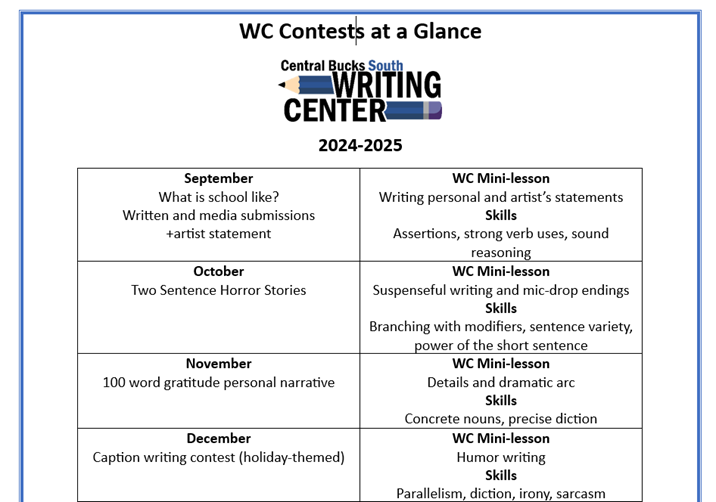
The contests need not be long and arduous, but they should offer a different challenge. Just like preparation for a road race vs a fun run, the prep work for contests requires teachers to zoom in and prioritize the skills and lessons that will support student writers during these writing experiences.
I have the unique opportunity to work with all teachers in all content areas in our school’s writing center. Recently, while I was working with social studies teachers on some writing contests, we specifically parsed the most important skills from their curriculum that corresponded with the specific writing contests they wanted to engage in.
For one of the contests, the prestigious David McCullough essay prize, we focused on developing writing lessons on defensible claims, integration of relevant and diverse evidence, and outlines for interpretive essays.
Another social studies teacher used the Fleet Reserve Association contest and we crafted lessons on balancing concrete and abstract nouns, expanding on detailed sentence structures, and writing clinching endings to paragraphs.
In both cases, the content area teacher wanted to focus on writing skills but needed a way to narrow these skills to best support writers. Looking at the requirements of a contest in tandem with course curriculum is an excellent way to chart the scaffolding that writers need to execute an authentic contest and challenge.
While training for any race, there are so many techniques to consider. But each race requires different priorities. The same is true for writing: we need slow and steady practice and swift and concentrated challenges.
Do you have additional questions or ideas for using writing contests? Send them my way @SouthWriting or jtannous@cbsd.org. Stay tuned for more posts about writing center pedagogy.
At Moving Writers, we love sharing our materials with you, and we work hard to ensure we are posting high-quality work that is both innovative and practical. Please help us continue to make this possible by refraining from selling our intellectual property or presenting it as your own. Thanks!
 moving writers