
March 25, 2025
The college entrance essay: Should we teach it or shouldn’t we?
This year, the guidance department of our high school, New Directions Secondary School in the Bronx, NY, asked me if I could teach a unit on the college entrance essay in our Juniors English class. In my career, the college entrance essay–with its 650 word limit and its potential to personalize a data-driven application process–has often been the domain of tutors or application specialists or counselors or parents, everyone except the English teacher. A fellow colleague even once argued we should not teach this essay. She made the case that since the essay is written outside the classroom’s lesson plans and feedback loops, this essay has more potential to demonstrate a student’s true abilities and expression.
And, of course, this makes sense. An application created independently would show the real strengths and weaknesses of the applicant. This was exactly how I submitted my o
wn college application in 1995. Yet now an entire industry of professionals has developed to help people with all aspects of the application from test prep to essay writing to college selection. Considering this, aren’t we just outsourcing the writing to others? If so, are we really confident in the integrity of others to lead students to their authentic voice? In addition, my students, 99% of which are eligible for free school lunch, do not have the resources to support them in this process.
So, I said, yes. And then I set about trying to figure out how to teach the college entrance essay in a way that avoided the expected tropes and cliches. Enter my favorite weapon of choice: metaphor.
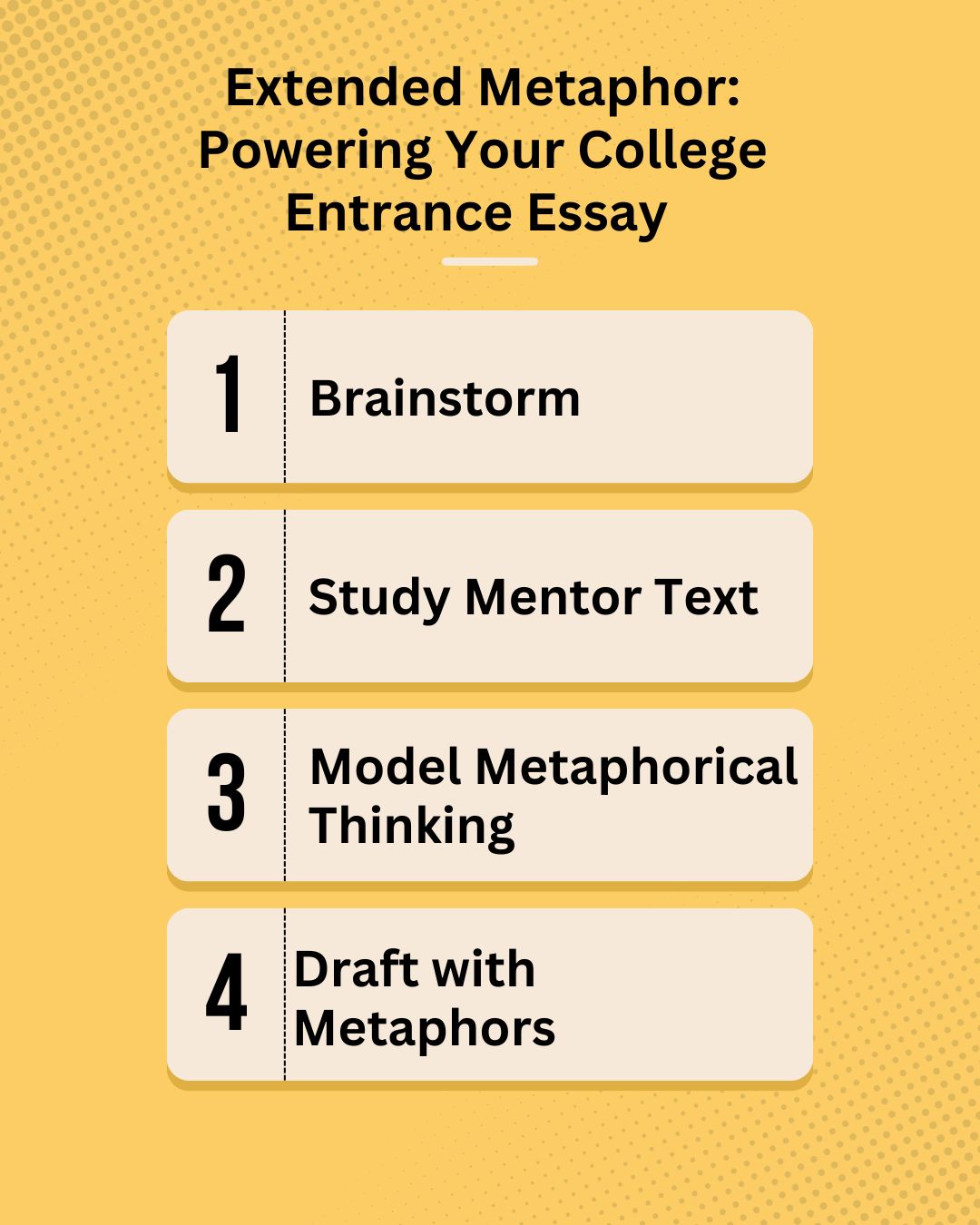
Stage One: The Brainstorm
My students engage in an opening writing activity almost every day. I give sentence starters, but I also encourage them to write freely. To start off this unit, I asked them to write a series of sentence starters that asked them to think of their lives within a metaphorical framework.
- My life is like putting together pieces of a puzzle.
- My life is like cooking for an important event.
- My life is like packing a bag for a journey.
- My life is like mining and polishing a diamond.
- My life has been a series of shedding skins, like a snake.
- My life has been like a spider spinning a web.
- My life has been like trying to untangle a knot that gets tighter the more I pull.
- My life has been like…. (add a metaphor, think of something that has movement, something that builds)
Next I asked students to consider challenges they have faced. The college entrance essay often reveals a challenge that a student faced and how it the challenge strengthened them. I gave them this list to get them thinking:
Possible Challenges
- Challenges with immigration
- Challenges with family or at home
- Challenges with mental health
- Challenges with discrimination
- Challenges with money in your household
- Challenges with interrupted education
- Challenge with parent’s disability or unemployment
- Challenge with a physical or learning disability
- Challenges with adjusting to COVID-19 lockdown
- Challenges of an injury or illness
- Challenge faced during playing sports
- Challenge of mastering a difficult skill
- Challenge of overcoming lack of confidence or shyness
- Another challenge: ______________________________________
Phase Two: Looking at a Mentor Text
I provided students with examples of college entrance essays on all of these challenges. Some helpful resources available online include: Connecticut College’s Essays That Worked, The New York Times’ College Essay Contest, Johns Hopkins University Essays That Worked and more. Having a variety of essays and topics encourages students to see the potential in the genre. I asked students to choose one to read each night for the first week of the three week unit. I also asked them to write a couple of sentences about why they think this essay helped that student earn admittance.
In class, I read aloud and annotated with the students the essay, Seeds of Immigration. Specifically, we mapped out the metaphor that organized the essay: the seed representing the writer, sprouted by their family, but blooming for themselves. We noticed all of the ways this metaphor was hinted at, through language like sprouted, bloomed, unknown soil, thirst, roots.
Phase Three: Metaphorical Thinking
As a class, we discussed how the metaphor of the seeds is a powerful one because it is a metaphor with a potential to change. We looked back at the metaphors that we wrote about in our notebooks: puzzle-solving, cooking, packing for a trip, mining and refining a diamond, shedding skins, spinning a web, untangling a knot. I then asked students, if you had to write one of these metaphors in stages, what would the stages be? How could these stage help you progress a metaphor in your essay?

For example, if you research how a spider spins a web, you discover lots of beautiful words and a process involving proto-webs, radial spirals, and capture spirals. I model how to think in metaphors for the students, teaching them to look for parallels between their challenge (technically called the tenor in a metaphor relationship) and the thing used figuratively to present their challenge (technically called the vehicle in a metaphor relationship).
Here’s how it might go:
- Facing a challenge might be a way of introducing the proto-web, feeling the winds and the instability of a location; these are also called exploratory threads.
- Finding supports, resources, ideas to help in a challenge: The spider places some triangles at the middle to help anchor what is to come. Are there moments that anchor a person as they prepare to face a challenge?
- What built your confidence in taking on a challenge? The spider creates an auxiliary spiral connecting the triangles at the center of the web.
- What actions did you take to overcome your challenge? What core qualities did you develop that will make you stronger for your future to come? At the end, the spider begins to weave sticky silk into a capture spiral starting from the outside moving inward. This will be the net that will provide for its future.
We look back at how the “Seeds of Immigration” essay built its metaphor over time. Often, the metaphor was just hinted at as the verbs of the seed growth were used as a verb of the student’s growth: sprouted, roots… Once a student explores a metaphor and states a metaphor at the beginning of the essay, it can simply be hinted at throughout without stating it directly again.
Phase Four: Drafting with Metaphor
I advise students to write about their challenge first. Here’s an outline they used involving the inciting incident, the challenge, the most intense moment in the challenge and their reaction to the challenge. Then I asked them to do the following:
- State their metaphor clearly somewhere in the first paragraph.
- Add at least three moments where they hint at the metaphor with verbs or other words throughout the essay.
- At the end, try to revisit the metaphor. Think about how the end of the metaphor might represent their hopes for the future (a web weaved, a knot untangled, a puzzle completed, etc.)
Have you taught the college entrance essay? I’d love to connect with you at K. A. Keener, English Teacher, New Directions Secondary School, or on Bluesky @kakeener.bsky.social.
At Moving Writers, we love sharing our materials with you, and we work hard to ensure we are posting high-quality work that is both innovative and practical. Please help us continue to make this possible by refraining from selling our intellectual property or presenting it as your own. Thanks!
 moving writers