

by Brett Vogelsinger
As an experienced high school English teacher, I’ve been struggling to come up with an apt analogy for generative AI tools in the writing classroom.
Some people compare AI in English class to the calculator in math class. This analogy quickly fails. As John Warner points out, calculators duplicate the “labor of the student” making “mechanical operations.” Conversely, while “the output of the [generative AI’s] algorithm may look similar to what a student produces in a course, the underlying labor is actually quite different.”
AI can hijack the thinking that happens during a writing process, so comparing AI to a calculator underestimates its potential threat to students.
The printing press, an optimist’s analogy, also fails. Tom Wheeler says, “Gutenberg released ideas and information from captivity; AI accelerates their analysis to produce conclusions that expand the boundaries of knowledge.”
Within the context of a classroom though, where young people are learning to write, the printing press gave them books full of ideas to synthesize with their words; AI gives them easy access to words that can be used to evade the construction of their own ideas. Comparing AI to the printing press overestimates its potential for helping students develop their own thoughts.
So I humbly suggest an alternative analogy, more fitting for the classroom: the microwave.
And to help me elaborate on this analogy, I want you to meet my mom.
In the mid 1980s through the early 1990s, as every American household incorporated the “microwave oven” into their kitchens, my household did not.
My mother opposed this development, taking pride in her own from-scratch cooking and the myriad skills she’d acquired over time. She was also skeptical of the health effects of “nuking” food for the family.
Plenty of teachers of writing right now feel the way my mom felt back then. They love the human connection that from-scratch student writing fosters, the quirkiness and the flavor. In the kitchen of school, they fear the culinary art of writing will be lost to a generation conditioned to push a button rather than mind a simmering pot of thoughts.
But cooking has not fallen out of fashion in the age of the microwave, even though we live in a culture where nearly everyone owns a microwave and uses it regularly. Why? Because many people enjoy the process of cooking, and nearly everyone prefers the taste of a home-cooked meal over any mass-produced freezer food ready for the microwave.
The value of the original art of cooking changes, but is not lost, with new technology.
In fact, at the same time microwaves became ubiquitous, Food Network started bringing fun-loving celebrity chefs to our televisions to teach us all how to cook–or at least to melt our stress as we watched them do it. Interest in cooking saw another surge during the COVID-19 pandemic when people had more time at home.
Certainly, in the twenty years that my mom avoided purchasing one, there have been families who eat only meals prepared in the microwave, and they are not likely to be the healthiest family in the neighborhood. Children raised without any from-scratch cooking will not even know what they are missing. So on one hand, my mom wasn’t wrong.
On the other hand, in most kitchens, the microwave became something that complemented traditional cooking methods. If there is someone in the family with the will, time, and desire to cook, they might integrate the microwave into their process for a recipe – melting the butter or steaming the frozen peas – but often it will not be the most critical tool. The traditional oven and stovetop, and food created with them, remain the gold standard.
While some people loathe cooking and other people loathe writing, isn’t it likely that humans of the future will still value the “flavor” that comes across in small-batch, human-crafted words? As isn’t it likely that in the process of creating text, humans will sometimes “microwave” an ingredient here and there, dipping into AI assistance to help achieve the flavor of the finished product?
In the same way that my mom and many other skilled cooks feel pride, satisfaction, and love as part of their cooking, learning to write well, with wit and wisdom, carry emotional and intellectual rewards that overreliance on AI shortcuts and the LLM’s approximation of human language fails to deliver.
My mom eventually bought a microwave, and when I called to talk to her about it as I wrote this piece, she offered, “I still don’t use it that much . . . but I wouldn’t want to be without it.”
As we continue to think through why, when, and how to incorporate generative AI in writing instruction, consider the microwave as your new analogy.
It stands by, ready to help capable cooks in important ways, but never the mainstay of their process. To rely on it extensively is to miss out on feelings of pride, satisfaction and love.
I’m not naïve. I know that this fall we will likely encounter a myriad new resources and guidelines around AI in our schools, likely with more fervor than we had last year and with little time to process them all. They won’t all agree with each other or with our own personal stance. But like microwaves entering the kitchens of the early 1990s, change is here.
Instead of unbridled enthusiasm or unqualified contempt for generative AI, let’s invest more time and energy in talking about the rewards of being a writer, the best ways to choose wisely from the gadgetry we have available, and the rich, abiding flavors humans craft out of words, punctuation, and our beautiful brains.
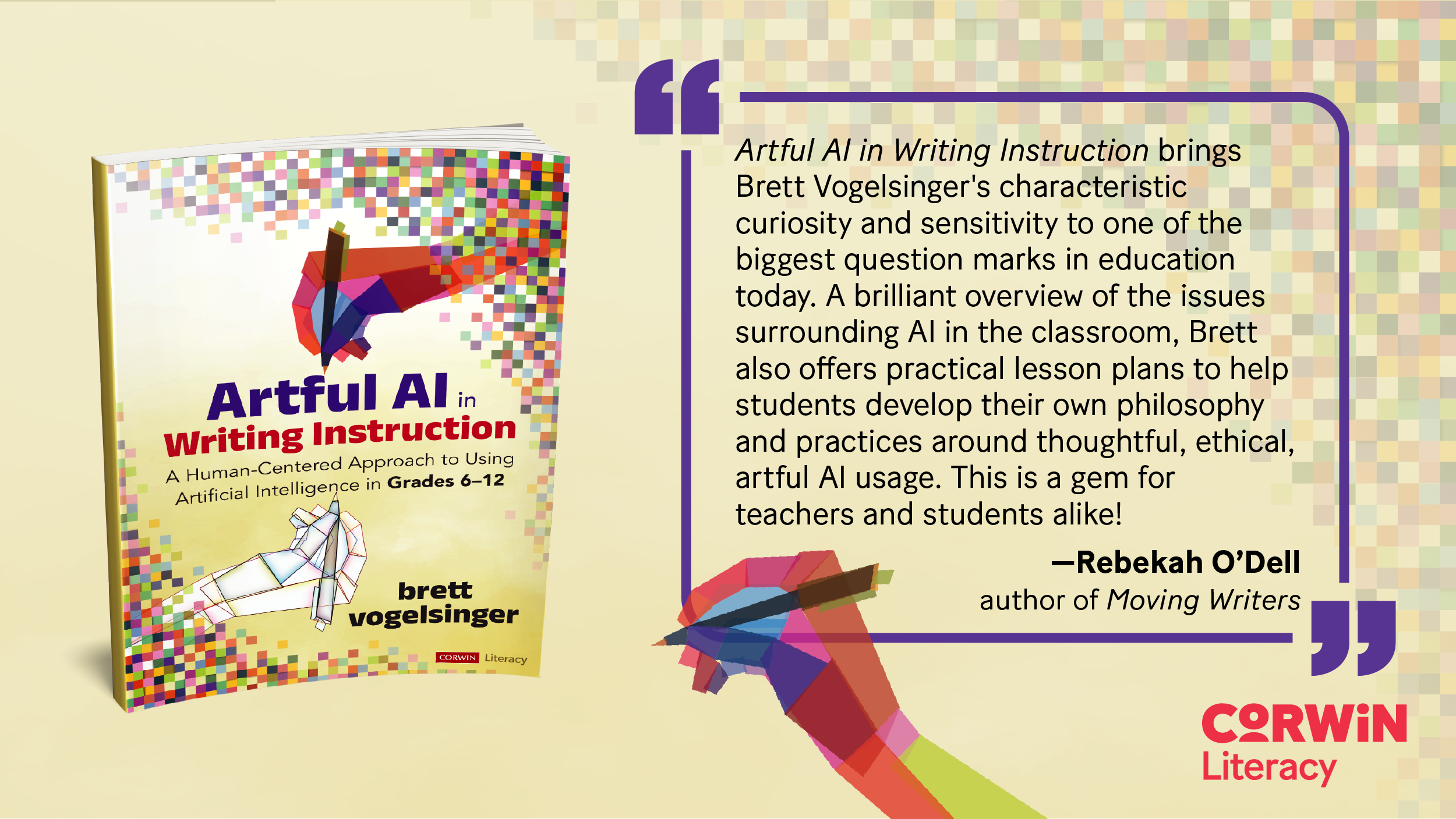
My new book, Artful AI in Writing Instruction: A Human Centered Approach to Using Artificial Intelligence in Grades 6-12 is now available from Corwin Press or on Amazon. My earlier book, Poetry Pauses: Teaching with Poems to Elevate Student Writing in All Genres is also available from Corwin Press or on Amazon. Tell me in the comments if you are already using ideas from either book, or how you plan to in the coming school year! You can connect with me on Bluesky or Instagram @theVogelman, on LinkedIn, or at my website www.brettvogelsinger.com
At Moving Writers, we love sharing our materials with you, and we work hard to ensure we are posting high-quality work that is both innovative and practical. Please help us continue to make this possible by refraining from selling our intellectual property or presenting it as your own. Thanks!
 moving writers
While I agree this is a better analogy, it is still inadequate. Your mom’s microwave did not learn new cooking techniques every time your mom warmed up leftovers in it. It does not make money for GE every time she uses it. She isn’t teaching her grandchildren how to brown, braise, roast, or steam in it. Well, maybe steam. And if she wants to brown, braise, or roast, how many additional features or tools does she need for the microwave?
Embracing calculators have not improved our students’ math skills. Grammar and spell check have not made our students better at writing mechanics. In both cases, student performance is generally worse. Embedded digital dictionaries have not made our students better readers. They’ve just become more dependent on a machine and less willing to use context clues to understand what they’re reading.
LLMs will do the same for thinking and writing. And we are foolish if we expect any different results.