
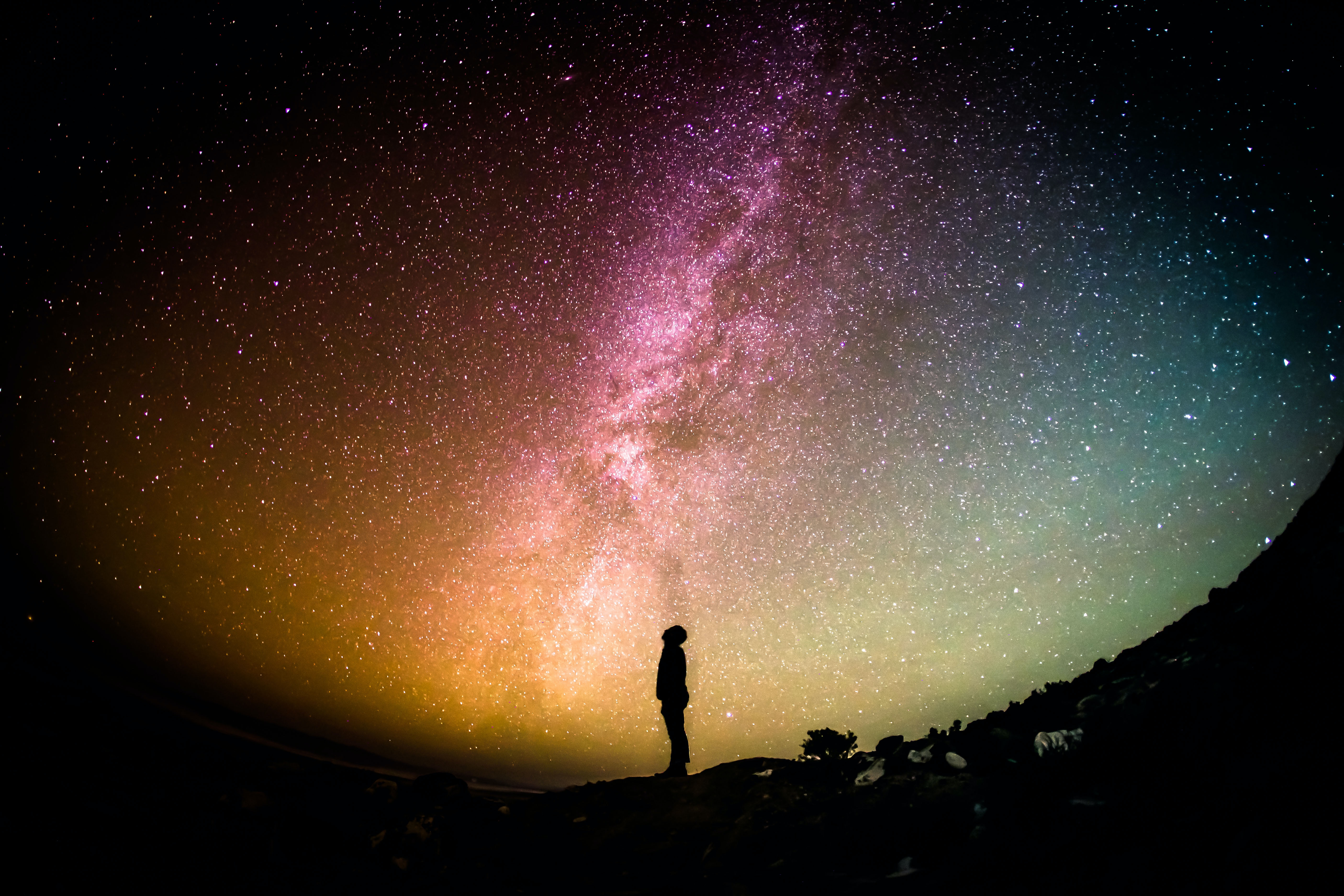
Ever since NASA began releasing images captured by the James Webb Space Telescope, I’ve become reacquainted with my child self’s way of thinking about space–how every Milky Way diorama, every glow in the dark star sticker affixed to the ceiling, every classroom poster of those dusty, celestial bodies evoked deep wonder. Part of the joy that comes from beholding recent Webb images is the realization that these pictures allow me to see something I thought I knew with new eyes: infrared astronomy is expanding our view of the universe, recalibrating our sense of the familiar by rendering observable that which was formerly hidden from sight.
Now, as an adult, I realize much of scientific discovery is an act of revision. As the new images test our basic ideas about our cosmic origins, scientists have been forced to rethink what we know about how the universe evolved and its current expansion. Unlike Hubble’s visible-light pictures, the pictures captured by Webb’s Near-Infrared Camera reveal stars previously concealed in seemingly opaque shapes. Webb’s sensitivity to much longer wavelengths enables it to peer through dust clouds, even allowing us to see a period of the universe’s history that we have not yet seen before.
The idea of revising one’s origin story can be enormously suggestive for students unsure of how to flesh out a personal narrative or appear reluctant to revise an initial draft.
This small, generative exercise described below is a perfect fit for classroom notebook time and can shake up a classroom writing routine by helping students consider a new vantage point.

Step #1: First, invite students to look at the juxtaposed images above. Viewers can observe clear differences between the 1995 Hubble image (left) and the 2022 Webb image (right) of the Pillars of Creation. The Pillars is the name of a nebula area where new stars are being created in M16, some 6,500 light years away.
Step #2: Invite your students to make a simple T-chart contrasting details seen in each image. It’s okay if they feel like their language is imprecise (I had to look up “interstellar medium”!). For my students, our chart looked like this:

Step #3: Invite students to write about a memory from childhood that is centered on a visualizable object. Encourage them to “foreground” the object, much like the Hubble Telescope image appears to highlight the Pillars of Creation.
Step #4: After a period of time, invite students to write about the same object again, but now in relation to other objects. Imbue the description with details about other items in the scene, much like the Webb Telescope illuminates activity around and within the Pillars themselves.
Since these directions can be abstract, I model the exercise with my own draft. I initially wrote about the classroom posters that were a regular feature in my childhood memories.
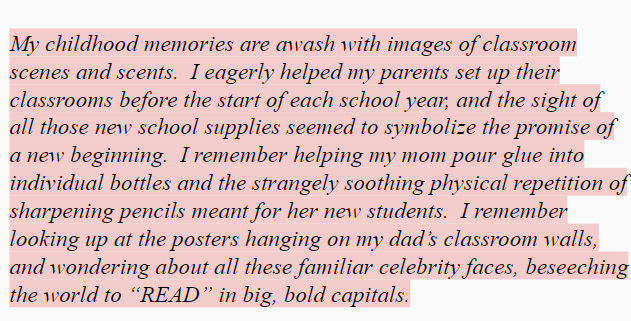
While describing the “READ” posters in the first drafting exercise, I became preoccupied with naming the celebrities and describing 80s fashion. In the second iteration, describing the posters as part of a constellation of objects allowed me to expand the scene in a more satisfying manner.
At this juncture, your students should have the makings of a personal narrative, reanimating some remembered scene from their own origin story. Writing with lenses has long been a ripe metaphor for writing instruction. We “zoom out” and “zoom in” based on how we wish to reveal our lives with details, hoping to flesh out a scene in our reader’s mind. Before I know what I want my reader to visualize, though, I need time to notice the “nooks” and “crannies” of my own memories. Posing the question – What does it mean to see your memories in infrared? – can help students reminisce and create new images of old and ancient stars.
-Xochitl
How are you bringing notebook time into your classroom this year? What have been successful entry points to writing personal narrative? Share your reflections in the comments below or find me on Twitter @dispatches_b222.
At Moving Writers, we love sharing our materials with you, and we work hard to ensure we are posting high-quality work that is both innovative and practical. Please help us continue to make this possible by refraining from selling our intellectual property or presenting it as your own. Thanks!
 moving writers