
by Kelly E. Tumy
It’s my birthday today, so I thought I’d post one of the most favorite lessons I taught-ever!
It really started out not as a lesson, so let me explain. I do love poetry; it took me a while to develop a good way to teach it to any grade level, though. It’s a practiced art–both written and taught–so don’t dismay if you are still finding your way. I adopted people like Billy Collins and Clint Smith, III, and I learned the economy of words is what matters in the craft–not who wrote them or how long ago they were written.
Poetry in my definition is just that: an idea expressed with an economy of words; almost always fewer words than prose. And I had to get students to recognize why poets communicate like this and how this form of writing does what other forms don’t. Enter poetry throw-down.

How It Started
Teacher burnout was at a high for me just after the AP English Language test one year. I needed something to keep my students busy and thinking, preferably the whole hour. I was reading Billy Collins’ book The Art of Drowning, and I came across a poem I wanted my students to do something with, but I wanted it to be a lesson driven by students and full of inquiry opportunities. The poem is titled “Shadow” and it has some of the most beautiful arrangements of phrases I’ve seen. I knew my students could tackle it; but remember, I needed it to last fifty minutes, and they needed to do the discovery. So I took an afternoon and wrote each word on part of a sentence strip, cut them all up, and put them in a basket for the next day.
The Class Arrives
Class started and I had my students move all the desks to the perimeter of the room. I told them to kneel on the floor and I said, “This is a poem with five stanzas. The first four stanzas have three lines, and the last stanza has four lines. The punctuation and capitalization are correct and there are no extra words. You can only ask me ten questions in the class period, so choose wisely. GO!”
They stared at me, asked if I was serious, and I simply sat at my desk and watched it unfold. It was May, so these juniors were self-starters, and natural leaders divided students into three or four groups. They all started looking to see how words and phrases went together; they had debates about the “correct” way a prepositional phrase was written (be still my heart!). Half the class was sure it started with the word Russian since it was capitalized. Then someone said, “All languages are capitalized guys, pay attention!”
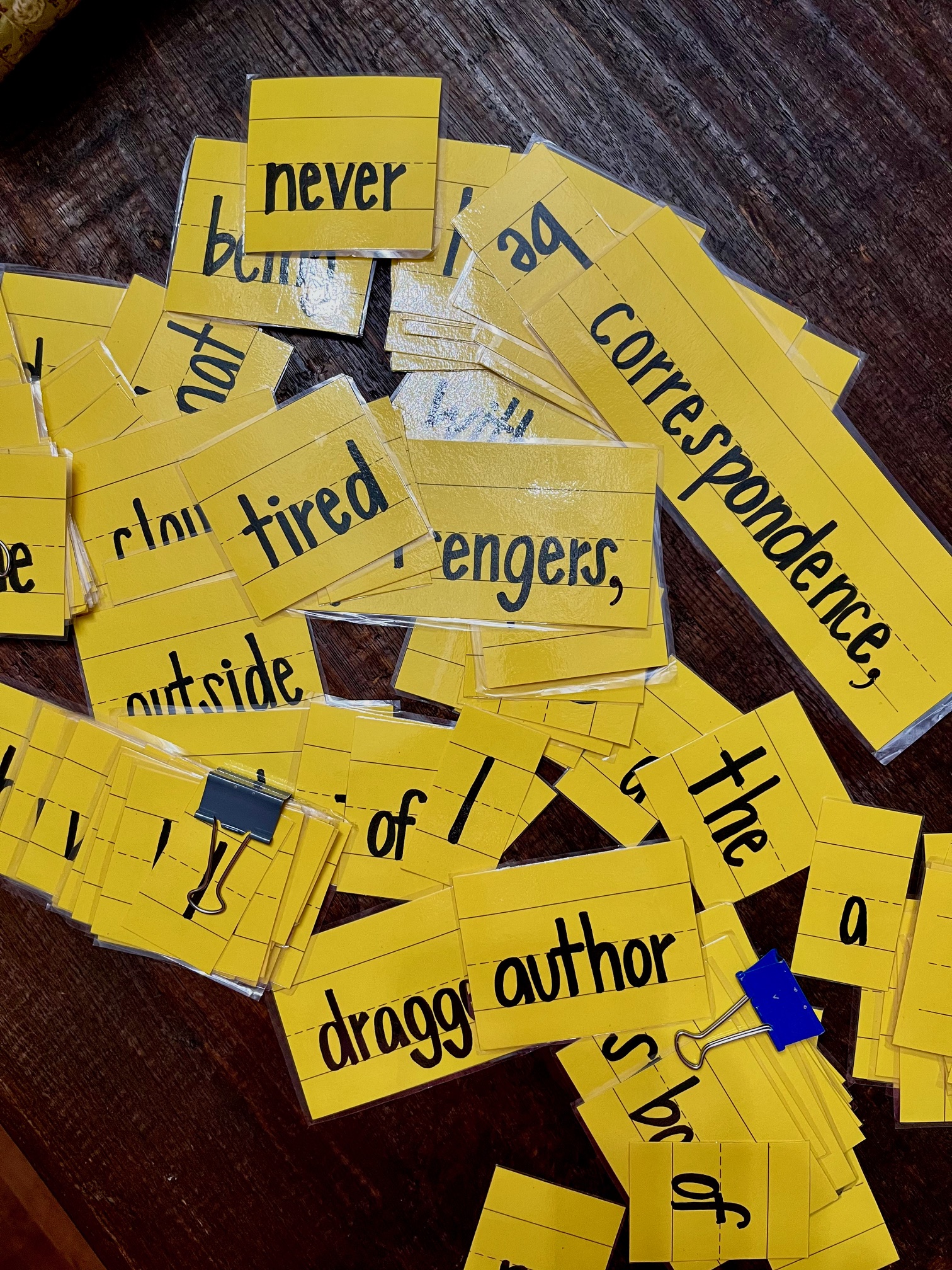
I sipped my tea at my desk and watched as they made connection after connection after connection. I did eventually give them the first line of the poem to give them a running start, and they got remarkably close in some instances. But the real learning for me was the eavesdropping. Students would say things like, “What do you mean by that ‘an author I can never look up and see? How does that make sense’?” And the student addressed would respond with a justification. If the group liked the idea, then they would let it stand. They would ask other small groups what they thought, and the majority would rule. They talked subject-verb agreement, someone diagrammed a clause to see where a certain word would need to go to make sense. It was learning made real before my eyes.
They put together an incredible poem that day–3rd, 4th, and 7th periods. It was nowhere close to “Shadow” by Billy Collins, but it was a valiant effort in writing a poem from a basket of words. They laughed, they fought (nicely), and they learned…all by themselves. As a bonus, I sipped hot tea at my desk and laughed and loved seeing the learning.
What I Learned
I could make a list of probably fifty items here, but here are the main ones:
- Students need to think their way through hard problems.
- Students want to try something new…really new.
- Students need each other to solve problems.
- Poetry should be engaging.
- Teachers can sit back quietly and watch.
- Teachers need to let learning happen…no matter the messiness.
This exercise was born of necessity, and it stayed due to the engaging nature of it as well as the student response to it. We only did it one or two times a year–but it was a hit each time.
I’ve taught this to teachers at multiple grade levels. I’ve used “Playing to the River” from *American Life in Poetry–Ted Kooser’s poet laureate project, with middle school teachers in professional development as well as a 7th grade class. I’ve used it with Jack Prelutzsky’s “The Witch” in 4th grade, and this time I kept two words together at a time and I told them which stanza the words went to. There are endless ways to scaffold this, and feel free to reach out and I will brainstorm away with you.
What It Became
Poetry Throw-Down became a way to make learning not only fun but it made learning visible in such a way that I hadn’t thought possible. Class discussions can fall flat without just the right mix of willingness and decorum. Written assignments can be tedious. Poetry Throw-Down became a way to engage the whole class and a way to see what students knew, and to watch their thinking unfold.
I enjoyed it in later years, walking around and flicking words out with my toe that were in the wrong place. It added to the air that this was simply a fun exercise…but it became something that guided their writing, their reading, and their thinking.
What different ways do you address inquiry? Teach poetry? Engage students? I would love to hear your ideas! You can find me on Instagram @Kellyreads_tx.
*American Life in Poetry may not be around forever. It was was sunsetted last December, but there are over 500 poems there, royalty-free, for teachers and daily news publications. They’ve stopped posting and maintaining the site, but there are some gems there.
At Moving Writers, we love sharing our materials with you, and we work hard to ensure we are posting high-quality work that is both innovative and practical. Please help us continue to make this possible by refraining from selling our intellectual property or presenting it as your own. Thanks!
 moving writers