Reader Mail: How can we help students better understand what they are doing in their own writing?

After the last installment of my four-part series on reading like a writer, I received a question from Lisa in Waunakee, WI about helping students better understand what they are doing in their own writing: “How to help students explain WHY/HOW an aspect of the piece (like a description, an added scene, a certain line, […]

Mentor Text Wednesday: Five Truths and a Lie about Paxton Avenue

Mentor Text: Five Truths and a Lie about Paxton Avenue by Jose Olivarez (pdf) Techniques: Writing Memoir Using a Structure Background –  In the first paragraph of this column, I usually reference my Twitter feed. I follow a lot of poets, not only because they share their work, but the poetry community is wonderful at sharing […]

Scaffolds for Helping Students Read Like Writers, Part IV (Trying the craft in your own work!)

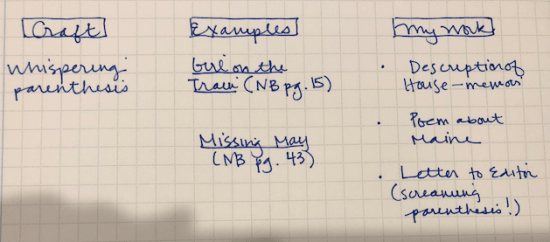
This whole scaffolding series has been building up to this last post. Everything we do to teach kids how to read like writers is in preparation for the last leap: trying the craft in your own work. In literature heavy classrooms, teachers may skip this step: The peak of literary analysis instruction is teaching students […]

Scaffolds for Helping Students Read Like Writer, Part III (Theorizing about Craft)

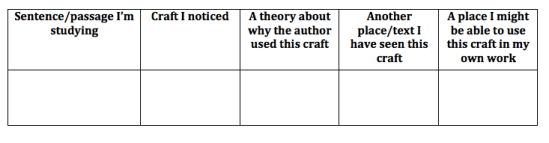
(Before diving in to today’s post, be sure to read the first and second posts in this four-post series about noticing and naming craft.) As we move deeper into the process of reading like a writer, we climb higher and higher on Bloom’s pyramid. After we notice and name craft, it’s time to consider why […]

I Get Wise with a Little Pop From My Friends

I want my students to be continually thinking about context–cultural, historical, and otherwise.  For many of my students, the boundaries of their writing AND reading are constricted by their narrow contextual pools of knowledge.  Helping them to see why the narratives of their history classes or the view through the microscope in biology are actually […]

Writing Our Way In: Exploring Drama Through A Soliloquy Study– Part One

On any day last week, a quick sweep of my three senior classes offered the same scene: gaunt, gray faces; foreheads on tables; backpacks exploding with papers; hair teased and tangled by frustrated fingers. It’s the October crunch, and my seniors are feeling the pressure of first quarter assessments, college applications, and fall SAT testing. […]

Making Research Relevant: Teaching Students to Synthesize Evidence

Every time I go to a workshop about research writing and synthesis (and I’ve been to a few since I teach both AP Language and AP Seminar), we talk about making smoothies or chocolate chip cookies or chili. In every instance–much to my disappointment– we’re not talking about eating, we’re talking about blending evidence effectively. […]